thm pwn101
THM - Pwn101 Writeup
Target: pwn101 | OS: Arch Linux
0x01: Initial Recon
Started with a quick checksec to see what I’m dealing with. The binary is x86-64 and most protections are stripped or disabled.
- NX is ON: So no shellcode on the stack.
- Canary is OFF: This is the green light for a Buffer Overflow.
- No PIE: Memory addresses are static, which makes things way easier.
0x02: Looking under the hood (Static)
Threw the binary into Ghidra. The main function is pretty straightforward—it takes input using gets(). As we know, gets() is a classic “security sin” because it doesn’t care about buffer limits. It’ll just keep writing until it hits a newline, perfect for smashing the stack.
0x03: Finding the Crash (Dynamic)
I ran the binary inside GDB-GEF. I needed to find exactly where the instruction pointer (RIP) gets hijacked.
- Used a cyclic pattern of 100 bytes.
- The app crashed, and GEF told me the offset is 64 (it might be different on your machine, but for me, 64 was the sweet spot).
0x04: The Attack Plan
The goal wasn’t just to crash it, but to control it. Since I’m running this on my Arch box, I wrote a quick python script using pwntools to:
- Send 64 bytes of junk (‘A’s).
- Overwrite the next part of memory to redirect the execution.
- Pop a shell
/bin/sh.
0x05: Exploit
I keep my exploit code separate for better workflow. Check it out here: exploitpwn101.py —
0x06: Result:
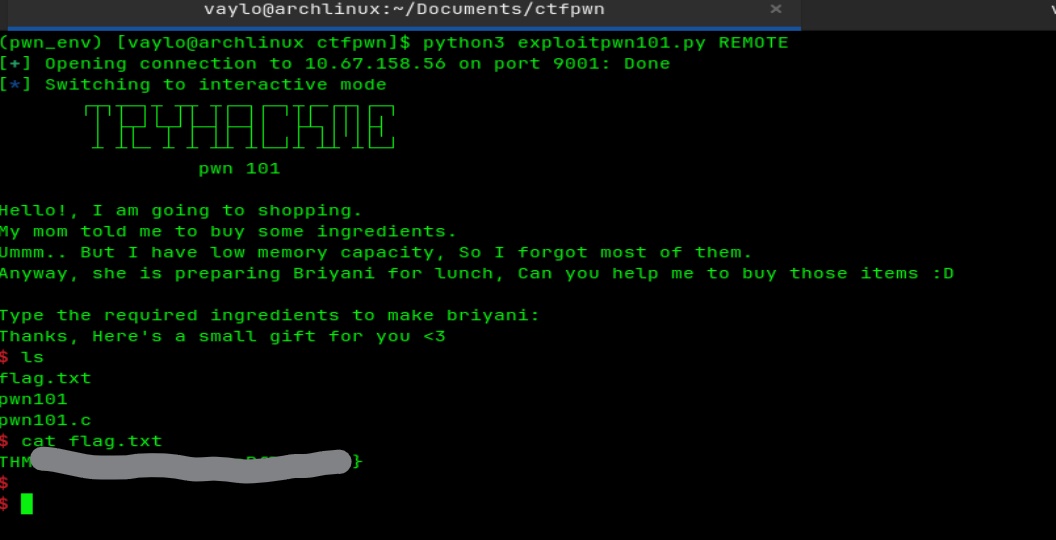 Got the shell. Game over. —-
Full Writeup & Files
View the exploit code and notes on GitHub.